
Did you know that a 2022 ESPN survey revealed that even basketball experts cannot agree on the greatest NBA players of all time? It is true. Ranking NBA legends is a thankless task. Disagreements are guaranteed. I am going to break down why these debates are so fierce, expose some hidden biases and offer a more balanced method for thinking about NBA all-time lists.
Why Everyone Argues About NBA Rankings
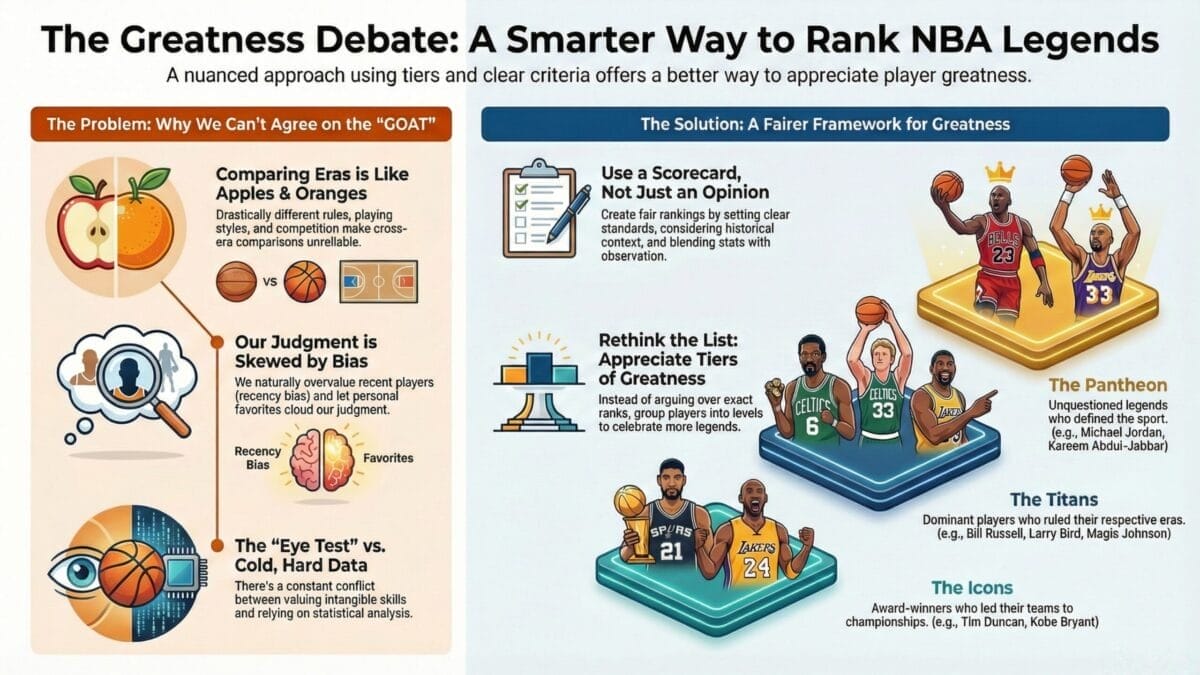
Unlike baseball, where statistics offer straightforward comparisons, basketball analysis is messier. How does one compare a dominant center from the 1960s with a modern point guard? The game has changed so much. Rule differences and contrasting playing styles across eras make it an apples and oranges situation.
Furthermore, there are no agreed upon standards. Should championship rings matter more than individual stats? Or what about a player’s overall impact, their longevity, peak performance or defensive skills? All these things matter. I would argue that weighting each factor differently is what causes the arguments.
The Conflict Between Watching and Analyzing
There is a split between those who trust their eyes and those who trust numbers. Those who favor the “eye test” value intangible things. Think about leadership, performing in clutch moments and defensive toughness.
Statistical analysis seeks an unbiased view using data. Traditional stats like points, rebounds and assists are used. Advanced metrics like Player Efficiency Rating (PER), Win Shares and Value Over Replacement Player (VORP) are also considered. Stats give good information. However, they miss important things. A player’s effect goes beyond what shows up in the box score.
Look at Dennis Rodman. His rebounding numbers jump off the page. Yet his real value was his tough defense and disruptive energy. Bill Russell’s championship record is amazing. Even so, his individual stats do not show his defensive importance and leadership. To truly evaluate players, I believe you need both to watch them and to analyze the numbers.
Fighting Recency Bias When Discussing NBA Greats
Recency bias is a huge problem. Things that happened recently seem more important than things that happened a long time ago. When ranking NBA players, this means current players get too much credit. Players from previous eras are unfairly forgotten. Nonstop media coverage makes this problem even worse.
Many fans never watched older players. They only know them from old videos and stories. That makes it hard to truly understand their skills and their impact. This lack of context creates biased rankings.
Consider Bob Cousy. Even with his Hall of Fame career, some people wonder if he could succeed now with today’s athletic point guards. Similarly, people downplay Wilt Chamberlain’s dominance. They focus on supposed weaknesses in his competition. The game is different now. It is important to remember the context in which these players played. They transformed their eras.
How the Media and Our Own Biases Affect Rankings
The media shapes how we view NBA legends. Some players get lots of positive attention. Others get criticized too much or are not well known. These media narratives affect how fans and analysts see a player’s career. That affects where they are placed on nba all-time lists.
Personal biases matter too. Everyone has favorite players and teams. Those favorites affect how we judge players. It is impossible to be completely unbiased, especially when judging players we feel strongly about. A Chicago Bulls fan might overrate Michael Jordan. A Los Angeles Lakers fan might favor Magic Johnson.
The Michael Jordan versus LeBron James debate shows this clearly. Both are amazing players. Fans let their love for one cloud their judgment. Instead of appreciating both players’ strengths, they argue about who is better. I think it is better to appreciate both!
A Better Way to Rank NBA Legends
To make fairer nba all-time lists, I suggest the following:
- Set Clear Standards: Decide how to judge players. Use things like championships, statistics, impact, longevity and peak performance. Give each thing a weight.
- Provide Context: Understand when a player played. Know the rules, the competition and their role. Do not compare players from different eras without knowing the details.
- Use Your Eyes and Stats: Combine what you see with statistical analysis. This gives a complete view of a player’s impact.
- Fight Recency Bias: Work against the urge to overrate current players. Do not undervalue older players. Study basketball history and appreciate players from the past.
- Admit Bias: Realize you cannot be completely unbiased. Accept that your preferences will affect your rankings.
Thinking Bigger: More Than Just the Top Guys
Instead of only focusing on the top 10 or 20 players, think about different levels of greatness. This lets you appreciate more of the great players in NBA history. Think about these levels:
- The Pantheon: The unquestioned legends (Michael Jordan, Kareem Abdul Jabbar).
- The Titans: Players who ruled their era (Bill Russell, Wilt Chamberlain, Larry Bird, Magic Johnson).
- The Icons: Players with individual awards who led their teams to titles (Tim Duncan, Kobe Bryant, Shaquille O’Neal).
- The All-Stars: Players who played at a high level and made multiple All Star teams (John Stockton, Charles Barkley, Karl Malone).
This system recognizes more achievements. It avoids arguments about exact rankings. It shows that greatness comes in different forms. Players can be great in different ways.
Examples of Controversial Rankings
Here are some examples of controversial rankings. They show how hard it is to create definitive NBA all-time lists:
LeBron James: How Will He Be Remembered?
LeBron James is the most debated player ever. Some call him the greatest. Others put him outside the top five or even ten. Supporters point to his longevity, his stats and his four championships. Critics say he is not as dominant as Michael Jordan. They say he benefited from a weak Eastern Conference for a while.
The stats help LeBron’s case. He has the NBA scoring record and ranks fourth in assists. He has four MVP awards. He took teams to the NBA Finals ten times. He won four titles with three teams. Critics point to his Finals record (4-6). They say he struggled in big moments.
Where LeBron James ranks is a matter of opinion. Regardless, it is vital to recognize his accomplishments and his impact. He is among the elite, no matter how he compares to Michael Jordan.
How the Center Position Changed
Basketball has changed. The center position has changed dramatically. Traditional centers like Shaquille O’Neal and Kareem Abdul Jabbar have mostly been replaced. Now, athletic big men shoot from the outside and handle the ball. This has created debates about modern centers versus older centers.
Some say modern centers are overrated. They say they lack dominant rivals at their position. Joel Embiid and Nikola Jokic are talented. Some believe they would have struggled more against Shaquille O’Neal or Hakeem Olajuwon. There is some truth to this. The game is different. Modern centers have different roles.
How much weight should one give to modern centers compared to past greats? That is up for debate. It is crucial to avoid broad statements. Think about the situations each player faced.
What is Next for NBA Lists?
As the NBA changes, expect more arguments about nba all-time lists. More international players and more emphasis on analytics will make it even harder to judge players and compare eras. I believe it is important to be open minded during these discussions.
One thing is for sure. People will never agree on the greatest players. That disagreement makes the debate so interesting. It pushes fans to learn about the game’s history. It celebrates their love for basketball.
I would say the most important thing is to appreciate all the players who have made the NBA what it is today. No matter their ranking, each player has had a lasting effect. Each deserves respect. Debating these rankings ensures NBA history is remembered.

Vince Douglas Gregory is the ‘petulant puppet master’ of a sports media landscape addicted to scripted rage and performance art. As the architect of VDG Sports, he bypasses the corporate talking heads to expose the unfiltered truth behind the narratives.
An unstable thinker and astute scholar, Vince thrives on dismantling the mediocre click-bait addicts who trade reality for engagement. If you want boring stats, go elsewhere. If you want the raw reality of the game, you’re in the right place. Consider yourself warned.