
Here is a startling statistic: arena attendance for the Golden State Warriors jumped almost 20% the moment Kevin Durant joined their ranks. The immediate question on everyone’s mind: was Kevin Durant a bus rider, or did he legitimately fuel their success? I am going to dissect this complicated debate and examine whether Durant was merely along for the ride or an essential piece of their championship puzzle.
This discussion is more than just about basketball scores. This is about legacy. This is about how teams function. This is about the true meaning of greatness. I will move beyond just points and rebounds to get to the heart of the matter.
What is a “Bus Rider” in Basketball?
Within the sports world, a “bus rider” is usually defined as a player benefiting from a high performing team without meaningfully contributing to its victories. This player is viewed as someone passively soaking up the glory earned by others. It is a very harsh label often reserved for players whose impact seems less critical than the team’s established stars. The central question I am addressing: does this label fit Kevin Durant?
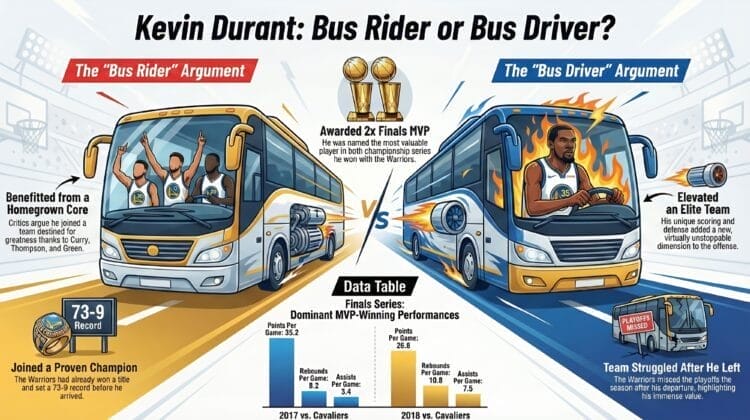
The accusation that Durant was “just a bus rider” during the Warriors’ dominant era implies he joined a team already destined for the history books, thanks to Stephen Curry, Klay Thompson and Draymond Green. People who believe Durant was a bus rider argue that Durant enhanced their success, but that he did not actually spark it. They insist he was simply a passenger.
The Warriors Before Durant: A Championship History
To truly understand this debate, one must examine the Warriors before Durant even arrived. Back in 2014-2015, they secured their first championship in 40 years, mainly fueled by Curry’s MVP performance plus a dynamic offense. The following season, they achieved a historic 73-9 record. They narrowly missed back to back championships after a painful loss to LeBron James and the Cleveland Cavaliers.
These achievements cemented the Warriors as a dominant force in the NBA. They possessed a distinct identity, a proven championship formula and a core of talented, homegrown players. This prior success is key evidence used by those arguing that kevin durant bus rider was simply along for the ride. They insist the Warriors were already contenders.
How Durant Elevated the Warriors
Even acknowledging the Warriors’ prior achievements, it is impossible to deny that Durant elevated them. His scoring ability, versatility and defensive skills added a completely new dimension to the team. Durant’s ability to create scoring chances in isolation gave the team a weapon they previously lacked. This made the Warriors incredibly difficult to defend. He was not just along for the ride. He actively improved the vehicle.
While Durant played for the Warriors, the team secured consecutive championships in 2017 and 2018. Durant earned Finals MVP each time. These titles solidified the Warriors’ dynasty status while cementing Durant’s place among basketball’s elite. However, these championships also intensified the “bus rider” whispers. Some suggested that Durant’s brilliance overshadowed the core Warriors players.
I often hear those two Finals MVP awards cited to refute the “bus rider” claims. These awards recognized Durant as the most valuable player in the championship series, implying he was a primary factor in the Warriors’ success. The opposing view insists that Durant’s scoring actually detracted from the team’s performance.
In the 2017 Finals against the Cavaliers, Durant averaged 35.2 points, 8.2 rebounds and 5.4 assists per game. During the 2018 Finals, he averaged 28.8 points, 10.8 rebounds and 7.5 assists per game. While these are impressive stats, they do not tell the entire story.
The Warriors’ success was rooted in teamwork, excellent ball movement and tenacious defense. Curry, Thompson and Green all played critical roles during those championship runs. Their contributions must not be dismissed simply because Durant received the MVP trophies.
Durant’s presence created opportunities for his teammates. He generated spacing and forced defenses to focus intently on him. His ability to score in isolation provided a crucial safety valve for the Warriors’ offense. Defensively, Durant was a valuable asset, disrupting shots and protecting the basket.
Durant’s willingness to embrace the Warriors’ system and play alongside other stars demonstrated his commitment to winning. He accepted his role within their offense, sacrificing individual statistics for the good of the team. This selflessness was a major factor in their ability to integrate Durant while achieving remarkable success.
Stephen Curry’s role as the team’s primary playmaker and offensive engine is undeniable. He architected the Warriors’ innovative offensive system. He was the driving force behind their ball movement and three point shooting. He was the emotional core of the team.
Curry’s willingness to share the spotlight with Durant exemplified his leadership and selflessness. He recognized that Durant’s talent could propel the Warriors to even greater achievements, and he embraced Durant as a teammate.
When Durant left the Warriors in 2019, after suffering a devastating Achilles injury in the NBA Finals, the narrative changed. The Warriors struggled significantly without Durant. They failed to reach the playoffs the following season.
These struggles highlighted Durant’s importance to the Warriors’ championship runs. His scoring, versatility and defensive prowess were sorely missed. The Warriors’ offense lacked its former explosiveness without him. Their difficulties after Durant’s departure served as a stark reminder of his value.
After recovering from his Achilles injury, Durant joined the Brooklyn Nets. Even when facing challenges, Durant has continued to perform at an elite level, showcasing his scoring ability and overall impact. His success with the Nets weakens the argument that he was “just a bus rider” because it demonstrates his capacity to lead while contributing to a team’s success independently.
Durant’s individual accomplishments with the Nets, including All Star selections and scoring titles, have solidified his position among the game’s all time greats. His ability to excel in diverse situations while sustaining his level of play diminishes the notion that his success with the Warriors was solely attributable to Curry, Thompson and Green.
The Superteam Era and Durant’s Choice
The NBA has recently seen a surge in “superteams.” Many star players have joined forces in order to pursue championships. This creates teams with abundant talent and a high probability of winning.
Durant’s choice to join the Warriors was not unprecedented. Players such as LeBron James, Kevin Garnett and Chris Bosh have made similar choices. They seek to enhance their chances of winning a title by joining forces with other stars.
Superteams often face criticism and accusations of “ring chasing.” However, it is important to recognize that these decisions often stem from a desire to compete at the highest level and achieve the ultimate prize. Durant’s move to the Warriors was a strategic decision intended to maximize his championship opportunities.
The media has greatly amplified the debate surrounding Durant’s legacy and whether he was simply a “bus rider.” Sports commentators, analysts and journalists have scrutinized Durant’s every move, dissecting his performance while questioning his motives.
Fan opinions are equally divided. Some view Durant as someone who abandoned his original team in order to join a ready made championship contender. Others appreciate Durant’s talent while acknowledging his contributions to the Warriors’ championship runs.
Ultimately, this boils down to legacy. How will Durant be remembered in NBA history? Will he be remembered as someone who joined a ready made championship contender or someone who elevated the Warriors to even greater heights?
I believe the answer probably hinges on Durant’s performance for the remainder of his career. Regardless of how Durant is ultimately remembered, his time with the Warriors will always be debated. The “bus rider” idea will persist, shaping perceptions of his career.
I do not believe there is a definitive answer. A careful examination of Durant’s contributions to the Warriors, the team’s inherent talent and the NBA as a whole is required. There are valid arguments on both sides, and individuals must form their own conclusions based on the evidence.
To label Durant a “bus rider” is unjust in my opinion. Durant integrated seamlessly into the Warriors’ culture and contributed significantly to their success. It is an oversimplified assessment that fails to capture Durant’s true impact on the Warriors. It is an inaccurate label.
I find that the debate surrounding Durant’s legacy continues. His tenure with the Warriors will always be a captivating narrative, a story of team dynamics, greatness and the ever evolving world of sports. Rather than questioning whether Durant was a “bus rider,” I believe we should appreciate his time with the Warriors plus the championships he helped them achieve. His success with the Nets demonstrates his talent and leadership, transcending the notion of him as a mere passenger.

Vince Douglas Gregory is the ‘petulant puppet master’ of a sports media landscape addicted to scripted rage and performance art. As the architect of VDG Sports, he bypasses the corporate talking heads to expose the unfiltered truth behind the narratives.
An unstable thinker and astute scholar, Vince thrives on dismantling the mediocre click-bait addicts who trade reality for engagement. If you want boring stats, go elsewhere. If you want the raw reality of the game, you’re in the right place. Consider yourself warned.