
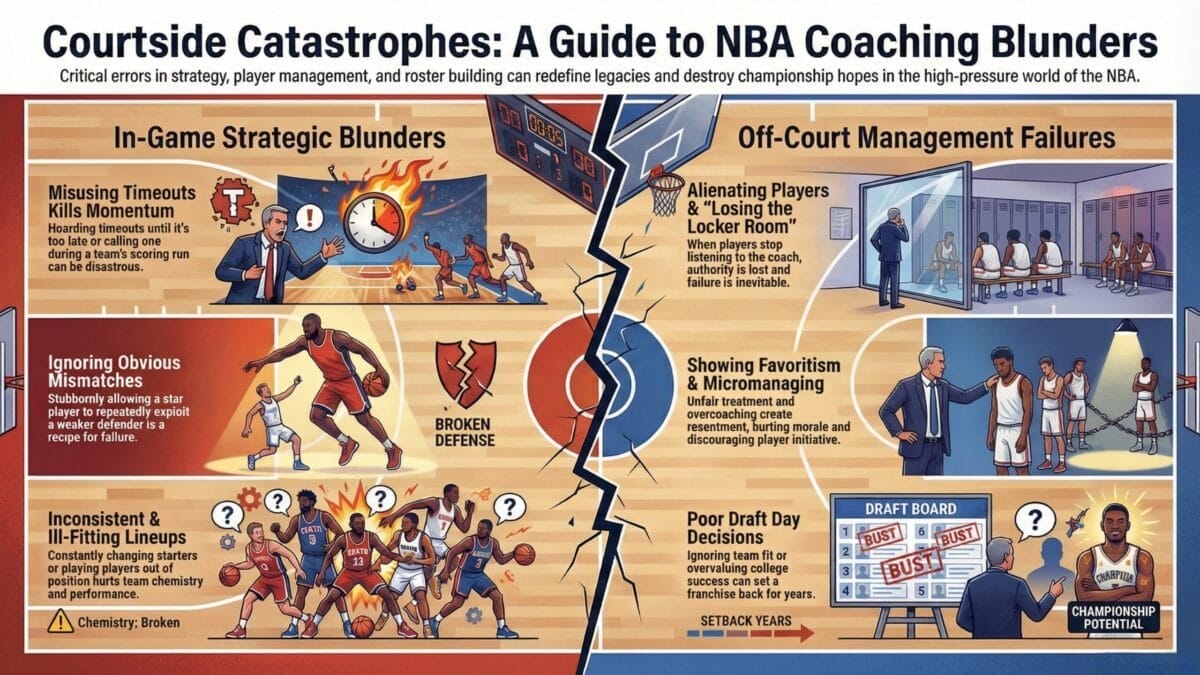
The NBA operates under intense scrutiny. Almost a fifth of NBA head coaches are feeling the heat, needing wins now to stay employed. In this pressure-cooker environment, every single strategic call carries enormous weight. A blown layup can mean the difference between victory and utter failure. Throughout the NBA’s history, numerous NBA coaching blunders have had devastating effects on teams. These mistakes are not minor oversights. They are critical errors that can redefine legacies, destroy championship hopes and bring careers to a grinding halt. I have personally seen decisions that made me question a coach’s basic knowledge of the game, substitutions that made no sense and strategic shifts that backfired in spectacular fashion. Let us examine some of the most shocking of these errors, analyzing the context, the (lack of) reasoning and what happened as a result.
In-Game Adjustments: A Dangerous Area for NBA Coaches
The NBA involves a constant stream of scoring runs, momentum swings and split-second choices. Coaches must react to these changes with quick decisions. A coach’s adjustments, though, can dramatically backfire, changing a manageable situation into a complete disaster. These adjustments then morph into severe problems.
Hack-a-Shaq: A Risky Tactic
The Hack-a-Shaq approach became well known in the late 1990s and early 2000s. The idea was simple: intentionally foul Shaquille O’Neal, a famously poor free-throw shooter, to take advantage of his weakness. While the thinking seemed reasonable, forcing the other team to score from the free-throw line, this tactic often slowed the game, created longer possessions, increased foul counts for other players and annoyed fans. Many consider it more of a gimmick than a real strategy, and its overuse became one of the more irritating habits coaches displayed. Was this one of the worst NBA coaching blunders?
The 2000 NBA Finals between the Los Angeles Lakers and the Indiana Pacers provides a clear example. Larry Bird, coaching the Pacers at that time, used the Hack-a-Shaq strategy a lot. While it bothered O’Neal and slowed the game’s pace, it also let the Lakers strengthen their defense and control the game’s flow. The Lakers won, and many think the Hack-a-Shaq strategy contributed to the Pacers losing.
Ignoring Mismatches: Stubbornness Leading to Loss
Matchups matter a great deal in basketball. A smaller, faster guard can take advantage of a larger, slower defender and the other way around. A coach who does not recognize and fix these mismatches is asking for problems. Imagine a coach stubbornly sticking to a defensive plan that is failing badly, allowing a star player to repeatedly exploit a weaker defender. This often causes easy points and a demoralized team.
I once saw a coach leave a struggling defender on an opposing player who was playing very well. The opposing player scored on nearly every possession, yet the coach would not make a change. That stubbornness cost them the game, showing the importance of being able to adapt while coaching.
Going Small Too Soon: Giving Up Size for Speed
The modern NBA emphasizes pace and spacing, with many coaches favoring smaller, faster lineups. Using a small lineup at the wrong time can be disastrous. A team that gives up too much size and rebounding ability risks getting dominated on the boards and outscored in the paint. Knowing when to use size and when to focus on speed and agility is important in NBA strategy.
I have seen teams replace bigger players with smaller lineups, only to get crushed on the boards and overpowered in the paint. It is a delicate balance, and coaches must carefully consider their team’s strengths and weaknesses before making such a big change.
Timeout Problems: Missed Chances and Lost Momentum
Timeouts are useful tools for coaches, allowing them to stop the other team from scoring, design plays, make substitutions and give players a short break. Poorly used timeouts can be as bad as not using them. These situations are prime examples of NBA coaching blunders.
Hoarding Timeouts: A Mistake
Some coaches hold onto timeouts, waiting for the right time to use them. This can backfire if the other team goes on a big scoring run, building a lead that is too big to overcome. A well-timed timeout can stop the momentum, disrupt the other team and allow your team to regroup. Waiting too long is a critical error.
I remember a game where a coach held onto three timeouts deep into the fourth quarter, yet did not use any until his team was down by 15 points with only a few minutes left. A comeback was not possible at that point. The other team had taken all the momentum, and his team could not recover. Saving timeouts makes no sense when the game has already been lost.
Calling Timeouts at the Wrong Moment: Disrupting Rhythm
Just as delaying a timeout can be bad, calling one at the wrong time can disrupt a team’s rhythm. If a team is playing very well, full of confidence and energy, a timeout can stop their momentum and allow the other team to regroup. It needs a careful approach, and coaches must consider the game’s flow before calling a timeout.
I have seen times when a coach called a timeout for no obvious reason during a team’s scoring run. When play started again, the team had lost its edge, allowing the other team to get back into the game. Sometimes, it is best to let a team that is playing well continue.
Drawing Up Bad Plays After Timeouts: A Failure
A timeout gives a coach a chance to design a play that will create a high-quality shot or an important defensive stop. If the play is badly designed or the players do not execute it well, the timeout is wasted. A coach’s ability to design good plays after timeouts is important to their skillset. Poor play design is an obvious error that fans easily recognize.
A coach has often called a timeout, carefully designed a play, only to see the team come out and commit a turnover or miss a contested shot. It is frustrating for everyone, the fans, the players and the coach. A well-designed play should consider the strengths and weaknesses of both the players and the opposing defense.
The Human Element: Broken Relationships
Coaching involves more than just strategy. It includes managing people, building relationships and creating a culture of trust and respect. A coach’s ability to connect with players can greatly affect their performance and the team’s success. The most significant NBA coaching blunders often come from failures in these relationships.
Losing the Locker Room: Alienating Players
When a coach loses the locker room, their time with the team is ending. Players may stop listening to the coach, question their decisions and try to undermine their authority. A divided locker room creates a bad environment, leading to poor performance, internal conflict and failure.
I have seen situations where players openly criticized the coach in the media or simply refused to follow the game plan. Recovery becomes very difficult once that happens. A coach needs the respect and trust of their players to succeed.
Showing Favoritism: Hurting Morale
Coaches must treat all players fairly, no matter their status. Favoritism creates resentment among players who feel they are not getting a fair chance. This can hurt team chemistry and lower performance. Playing favorites is one of the most damaging NBA coaching blunders a coach can make.
I remember a coach who consistently favored certain players, even when their performance was poor, while ignoring other players who worked hard and achieved good results. This created a sense of unfairness and hurt team morale. A coach must be objective and base decisions on player performance, not personal preferences.
Micromanaging: Discouraging Initiative
Guidance and structure are needed, excessive micromanagement can hurt player creativity and discourage initiative. Players need to be able to make decisions on the court and use their individual skills. Overcoaching can lead to hesitation, lower confidence and poorer play. A good NBA strategy includes empowering players.
There have been times when coaches exerted so much control that they told a player what to do every step of the way, leaving no room for improvisation. This is especially harmful to skilled players who rely on their instincts. A coach should provide a framework for success while also allowing players to express themselves within that framework.
Draft Day Problems: Bad Talent Evaluation
The NBA Draft is an important event for teams wanting to build for the future. A good draft can produce a franchise player, a valuable role player or assets that can be traded. A bad draft can hurt a team for years. These mistakes do not solely fall on the coach, they often show a disconnect between the coaching staff and the front office. These are considered NBA coaching blunders because the coach provides input.
Drafting on Potential Alone: Ignoring Warning Signs
Some teams are drawn to potential, drafting players based on their perceived upside while ignoring weaknesses and warning signs. This is risky, as potential does not guarantee performance. A careful evaluation of a player’s skills, work ethic and character is important before committing a high draft pick.
I have seen many teams draft players with great potential who failed to live up to expectations. Sometimes, these players lack the work ethic, mental strength or coachability to succeed in the NBA. A thorough scouting process is needed to find players who have both the talent and the character to thrive.
Ignoring Team Fit: Selecting Players Who Do Not Complement the Roster
Drafting players who complement the team and work well with the current roster is important. Selecting a player who does not address a need or fit with the team’s playing style is a wasted draft pick. A smart NBA strategy involves acquiring players who can fit into the team and help it succeed.
There have been times when teams drafted players who were the same as existing players or did not fit the coach’s system. This can create problems at certain positions and limit the team’s flexibility. The coach and general manager must work together to find players who can address the team’s weaknesses and build on its strengths.
Overvaluing College Success: Misjudging NBA Potential
Dominance in college does not guarantee success in the NBA. Some players do well in college because of their size, athleticism or experience but struggle to adapt to the faster, more physical NBA game. Accurately assessing how a player’s skills will translate to the NBA and avoiding too much reliance on their college achievements is important.
I have seen many college stars fail to make an impact in the NBA. Sometimes, these players lack the athleticism, skills or mental toughness to compete against elite competition. Carefully evaluating a player’s potential at the NBA level is needed to avoid drafting a player destined to underperform. Many call this one of the worst NBA coaching blunders.
The Enigma of Lineup Rotations: When Too Much Change Creates Problems
Identifying the best lineup combinations is important in coaching. A coach’s ability to know which players work well together and create effective units can affect a team’s success. Too many lineup changes can cause confusion, hurt team chemistry and prevent consistent performance. This is a common mistake that coaches make.
Constantly Changing Starting Lineups: Hurting Team Chemistry
Changing the starting lineup too often can hurt team chemistry and prevent players from establishing their roles. Players need consistency to develop rhythm and build trust with their teammates. Constant lineup changes can create uncertainty and lower confidence. This is an NBA strategy that needs careful consideration.
I remember a season where the coach never seemed happy with the starting lineup, constantly trying different combinations. This created unease among the players, and the team never developed real chemistry. A coach should keep a core group of starters they trust, making changes only when needed.
Playing Players Out of Position
Assigning players to unfamiliar positions can have bad results. Players do best when used in positions that fit their skills. Forcing a player into an uncomfortable position can lead to poor play and frustration. These mistakes can be avoided.
There have been times when coaches tried to convert guards into forwards or forwards into centers, with bad results. Players need to be in positions where they can use their strengths and minimize their weaknesses. A coach should try to improve players‘ skills while also recognizing their limitations.
Too Much Reliance on Specific Lineups: Failing to Adapt
Some coaches favor certain lineups, even when they are not effective against certain opponents. Being able to adapt is important, and coaches should adjust their lineups based on the strengths and weaknesses of each opponent. A coach should have different lineups and be willing to adapt based on the situation. This is important in NBA strategy.
I have seen times when coaches stubbornly stuck to the same lineup, even though it was clearly ineffective against a particular opponent. This makes the team predictable. A coach should be able to adjust lineups based on the opposing team’s players and playing style.
The Legacy of Regret: Coaches Who Failed
The NBA focuses on results, where coaches are judged on their ability to win and lead their teams to championships. Some coaches, despite having talent and experience, do not meet expectations because of strategic errors, poor player management or bad luck. The history of the NBA has coaches whose careers involve regret and unrealized potential. Their names are often associated with significant NBA coaching blunders.
The Case of [Hypothetical Coach A]: A Promising Start That Failed
[Hypothetical Coach A] started as a highly regarded assistant coach who got his first head coaching job with a young, talented team. He was known as a smart strategist and a good communicator. He struggled to turn his ideas into real success. He made questionable lineup choices, did not adjust during games and lost the confidence of his players. He was fired after several disappointing seasons, and his career never recovered. His story shows the challenges of going from assistant to head coach and the importance of being able to adapt.
The Downfall of [Hypothetical Coach B]: A Veteran Coach Unable to Change
[Hypothetical Coach B] had a long career. He struggled to keep up with the changing NBA. He resisted new offensive and defensive strategies and did not connect with younger players. His teams became predictable, leading to his replacement by a younger coach. His experience shows the importance of always learning and being able to adapt in coaching.
The Unrealized Potential of [Hypothetical Coach C]: A Talented Strategist
[Hypothetical Coach C] was good at designing offensive and defensive systems. His leadership skills were lacking; he could not inspire his players. He struggled to build relationships, manage egos and create a good team environment. His teams had talent but underachieved, preventing him from reaching his full potential as a coach. His story shows that coaching is more than just strategy. It also requires leadership, communication and creating a strong team culture.
Learning From Past Mistakes
The NBA’s history has lessons, both good and bad. Coaches can gain insights into effective and ineffective strategies by studying past errors. Adaptability, communication, player management and strategic flexibility are important for success in the NBA. We cannot change the past, but we can learn from it and make informed decisions. Coaches can improve their chances of leading their teams to victory and establishing a lasting legacy by recognizing and avoiding these common NBA coaching blunders. The average NBA team is worth over $3 billion. Ensuring you have a championship winning coach is worth every penny. As I’ve seen with my own eyes, the coaches that are willing to learn from the mistakes of others are the ones who end up hoisting the Larry O’Brien trophy.

Vince Douglas Gregory is the ‘petulant puppet master’ of a sports media landscape addicted to scripted rage and performance art. As the architect of VDG Sports, he bypasses the corporate talking heads to expose the unfiltered truth behind the narratives.
An unstable thinker and astute scholar, Vince thrives on dismantling the mediocre click-bait addicts who trade reality for engagement. If you want boring stats, go elsewhere. If you want the raw reality of the game, you’re in the right place. Consider yourself warned.